


MechLab · UPV Campus d’Alcoi
Equipment
Testing and manufacturing equipment in the lab.
The lab
Main equipment
This equipment is used in research projects, doctoral theses and bachelor’s and master’s theses.

3D optical profilometer
Measures surface topography and roughness without contact. We mainly use it to measure the wear tracks left after tribometer tests.
- Profilm3D model
- Non-contact optical measurement
- 3D surface maps and roughness profiles

Pin-on-disk tribometer
Friction and wear testing with a pin sliding on a disc or plate. Motion type, contact, speed, lubricant, materials and humidity can all be changed.
- Pin-on-disk configuration
- Linear and reciprocating motion
- Dry and lubricated tests
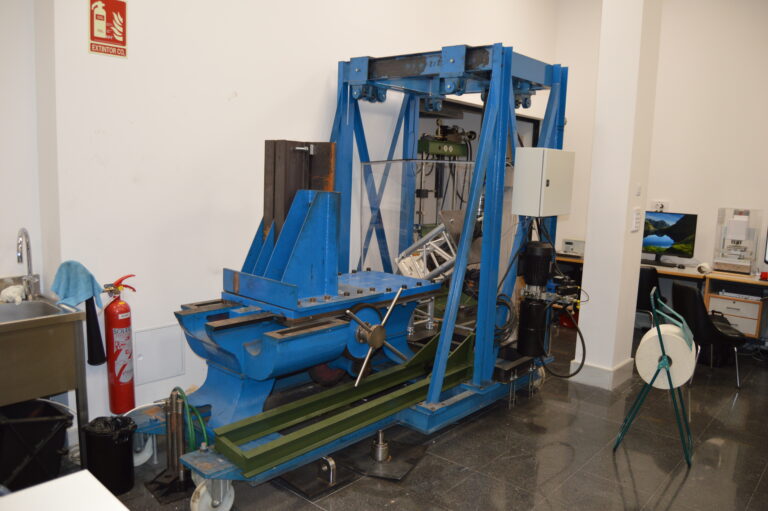
Plastic deformation processing simulator
Measures the friction between sheet and tool while the sheet is being deformed. It also works with high-strength steels.
- Elongation of test pieces of any material
- Friction coefficient determination
- Adjustable pin angle, temperature and diameter
- Displacement and force sensors on both arms

Fatigue testing machine
Runs four fatigue tests at once, so several conditions can be compared on the same material. It is set up for composite specimens.
- 4 simultaneous tests
- Designed for composite materials

Creep and relaxation testing
Measures how much a material deforms over time under constant load (creep) and how stress drops when the strain is held fixed (relaxation).

Induction heating
Induction heating of metals and other conductive materials for hardening, joining or softening. Heating is fast and easy to control and repeat.
- GH DIGIMAC 10SH300 generator
- Frequency range 50 to 300 kHz
- Independent cooling unit
- Two coils of different diameters

3D printers
Filament printers for making test specimens and prototypes. They are also used in research on parts printed with polymer filaments containing conductive fillers.
- Artillery Genius
- Fused deposition modelling (FDM)
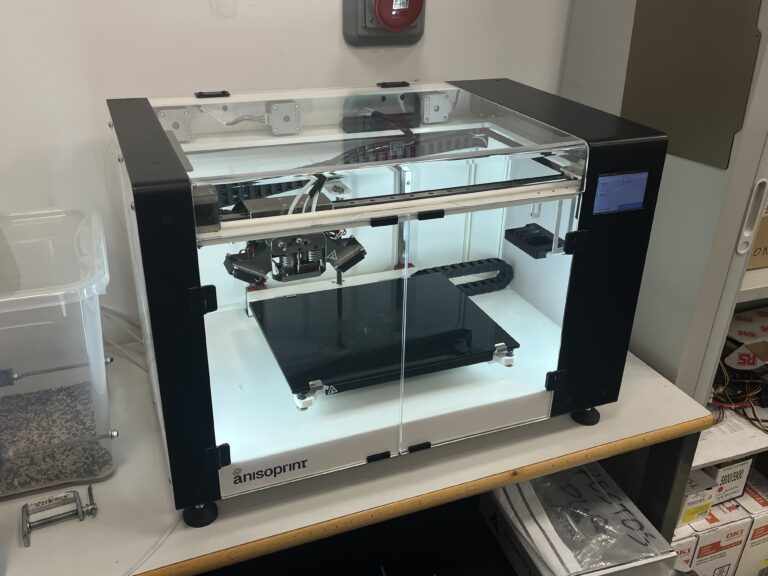
Continuous fibre 3D printer
3D printer that reinforces parts with continuous carbon or basalt fibre. One extruder prints the plastic and the other lays down the fibre together with plastic (co-extrusion), so the reinforcement goes only where it is needed.
- Anisoprint Composer A4
- Composite fibre co-extrusion (CFC) and FFF
- Continuous carbon or basalt fibre
- Two extruders: plastic and composite
- Build volume of 297 × 210 × 140 mm
400,000 fps
High-speed camera
Records at high speed what happens during a test, such as a fracture or an impact.
- Phantom M/LC 110, monochrome
- 12-bit CMOS sensor, 1280 × 800 pixels
- Up to 400,000 fps (at 128 × 8)
- 5,090 fps at 640 × 480 and 1,630 fps at 1280 × 800
- Two 7,700-lumen lights
For enquiries about using this equipment: mechlab@upv.es.